Employee Transportation Contracts in Riyadh: A Decision Guide

In this article11
- Contents
- When does employee transportation become a contract decision?
- What does a JTEX employee transportation contract include?
- How do you define employee transportation requirements?
- Which vehicles suit employee transportation?
- Which questions settle the choice of operator?
- How do you compare employee transportation proposals?
- What are the stages of moving to an employee transportation contract?
- What factors determine the cost of an employee transportation contract?
- Employee transportation: examples of fleet categories
- Frequently asked questions
A long-term employee transportation contract is the right choice when a steady number of your staff move every day on recurring times, and when a stoppage costs more than securing the movement. The contract gives you dedicated vehicles, employed drivers, approved routes, a fixed schedule and an operations team for the full term. This guide helps HR, procurement and facilities managers decide: whether to contract, at what scope, with which vehicles, and which questions settle the choice of operator.
When does employee transportation become a contract decision?
Three signals show that an organisation has outgrown ad hoc solutions:
- Recurrence: the same movement happens every working day, morning and evening, or with every shift.
- Dependency: a late arrival genuinely disrupts work: a factory shift, a clinic, a training room, a call centre.
- Governance: management needs documented routes, driver records and monthly reporting, not scattered invoices.
When two of these are present, transport is a utility like power and connectivity, and utilities are contracted. In JTEX’s words: a contracted agreement is not a transportation deal; it is a strategic decision that guarantees uninterrupted operational continuity.
What does a JTEX employee transportation contract include?
A contract under our long-term contracted transport services rests on four pillars:
- Dedicated vehicles assigned to your organisation for the term, owned by JTEX and maintained on its schedule.
- Employed drivers fixed to the routes, who know the pick-up points and the people, trained to the service standard.
- Fixed schedules and approved routes designed with the organisation and reviewed periodically.
- An operations team and monitoring around the clock for the contract term, with a clear replacement procedure and periodic reporting.
The wider background to this model in the Kingdom is covered in our guide to long-term contract transportation in Saudi Arabia.
How do you define employee transportation requirements?
Scope is the difference between a contract that serves you and one you pay for without using fully. Decide before requesting proposals:
- Who moves: staff on group routes, executives in dedicated vehicles, or both.
- Geography: pick-up points in districts or residential compounds, and the headquarters or multiple sites.
- Timing: single shift, rotating shifts, weekend work or night operations.
- Variability: does headcount change seasonally or with projects? This sets the contract’s flexibility.
- Supporting services: airport runs for visitors, delegation transport or internal events added on demand on top of the contract.
Which vehicles suit employee transportation?
The vehicle is chosen per route size, not total headcount, because a single low-volume route does not need a full-size bus:
| Route pattern | Suggested vehicle | Why |
|---|---|---|
| High-density group routes between compounds and headquarters | Full-size buses (Yutong, King Long) | Best efficiency per route, suited to main roads |
| Medium routes or districts with narrower streets | Toyota Coaster | Mini bus that is agile in traffic and parking |
| Small teams, late shifts or scattered pick-up points | Toyota Hiace | Practical van for small groups at a sensible operating cost |
| Middle management or executive teams | Hyundai Staria | VIP van with executive seating appropriate to the passengers |
Details of the bus layer are on our bus transportation service page. We do not state specific capacities as commitments; the actual combination is set when the routes are studied.
Which questions settle the choice of operator?
Before you sign, make sure you are asking the right questions; the difference between a supplier and an operational partner shows in the answers:
- Are the vehicles owned by the operator or hired from a third party? Who carries maintenance and replacements?
- Are the drivers its employees, and what are the vetting and training procedures?
- What happens on a morning when a vehicle fails or a driver is absent? What is the replacement time and mechanism?
- How are trips monitored during operations, and do we receive punctuality reports?
- How does pricing change with headcount or route changes mid-contract?
- Who is the named account manager, and what is the escalation path?
JTEX answers these with a stable, scheduled and monitored operating system for the full contract term, owned vehicles, employed drivers and one accountable account team.
How do you compare employee transportation proposals?
Do not compare headline totals alone. Put the proposals on one table covering: vehicle class and age, reserve ratio, operating hours covered, what counts as an additional route, the scope-change mechanism and the reporting level. A cheaper proposal with third-party vehicles and no reserve can cost more in the first week a route fails.
What are the stages of moving to an employee transportation contract?
Moving from scattered arrangements to a managed contract does not happen in a day. It follows four clear stages that protect the organisation from any interruption:
- Route study: we take the staff data, pick-up points and working hours, and draw the proposed routes, their timings and the vehicle class for each.
- Review and approval: the organisation reviews routes, stops, reserve ratio and reporting requirements, which are then fixed in the contract.
- Structured launch: drivers are briefed on routes and pick-up points before day one, and staff receive the schedules and a contact point.
- Periodic review: after the first weeks, punctuality data and staff feedback are reviewed and routes adjusted where needed.
With this sequence the contract starts stable on its first day and improves with every review, instead of problems being discovered during operations.
What factors determine the cost of an employee transportation contract?
We do not publish prices, because each contract is studied on its routes, but the factors are clear: number and class of vehicles, number and length of routes and daily trips, operating hours (single shift or rotating), contract term, reserve capacity ratio and reporting requirements. The more precise your data, the closer the proposal is to your real need.
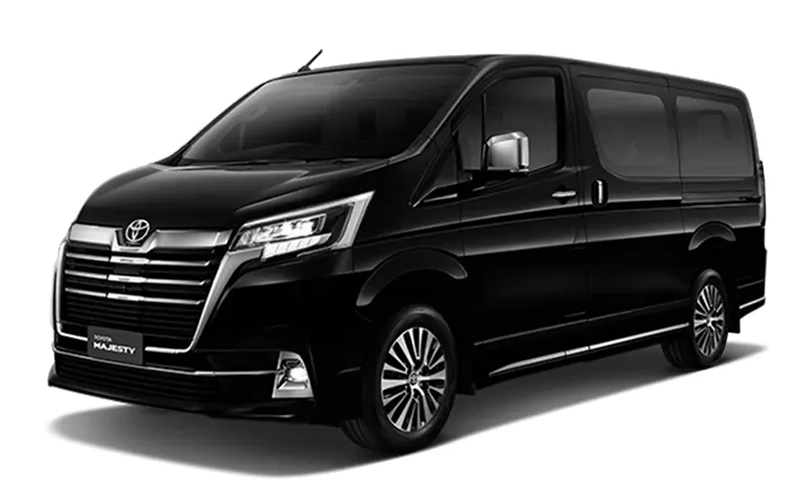
Employee transportation: examples of fleet categories
These examples show JTEX vehicle categories. Confirm the allocation against passenger numbers, routes and contract requirements.


Frequently asked questions
Is there a minimum headcount for a transportation contract?
No fixed minimum; the contract is built around routes, not headcount. A small team with one fixed daily route may be served by a single-van contract.
Can routes be changed after signing?
Yes. Routes and times are reviewed periodically with the account team and adjusted through a change procedure agreed in the contract.
What happens if a vehicle breaks down in the morning?
The replacement procedure is activated from the operations desk using reserve capacity, and the organisation’s coordinator is informed immediately.
Do contracts also cover executive transport?
Yes. One contract can combine group employee routes with dedicated chauffeured executive vehicles for management.
Do you operate contracts outside Riyadh?
Riyadh is the operating base, and JTEX runs intercity movement for contracts and projects across the Kingdom according to each contract’s scope.
Request a study of your organisation’s needs. Send your estimated headcount, pick-up points and working hours to JTEX on WhatsApp or through our contact page, and our contracts team will return a route design, vehicle combination and quote.